Photo by Walt Peterson
|
 y now you are probably
thinking: "So what's new? Except for the friendly whales, I have encountered
all these animals and plants in the southwestern US, and in mainland Mexico.
What's so special about Baja?" The answer is a great deal-look closer!
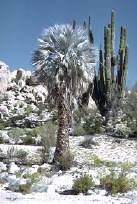
There are striking plants adapted to extreme dryness that are endemic (found
only in one area) to Baja, such as copalquín, cardón,
and "boojum," which are found only in Baja and small areas on the mainland,
and torote, a "tree" virtually identical in appearance to copalquín
found only in Baja, mainland Mexico, and small areas in the southwestern
US.
y now you are probably
thinking: "So what's new? Except for the friendly whales, I have encountered
all these animals and plants in the southwestern US, and in mainland Mexico.
What's so special about Baja?" The answer is a great deal-look closer!
There are striking plants adapted to extreme dryness that are endemic (found
only in one area) to Baja, such as copalquín, cardón,
and "boojum," which are found only in Baja and small areas on the mainland,
and torote, a "tree" virtually identical in appearance to copalquín
found only in Baja, mainland Mexico, and small areas in the southwestern
US.
 s the peninsula
split away from the mainland in the manner described above, the Cortez
became wider and longer, and the animals and plants living on the peninsula
became isolated; to visit the mainland with breeding in mind, for instance,
a bird had to fly over a lot of water or make a long detour. As a result
of this isolation, a number of bird species evolved in ways different from
their mainland counterparts. There are now four endemic bird species and
subspecies to be found in Baja, three of which are so numerous that visitors
should have little problem sighting them. The Cortez even has its own endemic
marine mammal, the Gulf of California (an alternate name for the Cortez)
harbor porpoise. Found only in the northern Cortez, it is one of the rarest
animals on earth.
s the peninsula
split away from the mainland in the manner described above, the Cortez
became wider and longer, and the animals and plants living on the peninsula
became isolated; to visit the mainland with breeding in mind, for instance,
a bird had to fly over a lot of water or make a long detour. As a result
of this isolation, a number of bird species evolved in ways different from
their mainland counterparts. There are now four endemic bird species and
subspecies to be found in Baja, three of which are so numerous that visitors
should have little problem sighting them. The Cortez even has its own endemic
marine mammal, the Gulf of California (an alternate name for the Cortez)
harbor porpoise. Found only in the northern Cortez, it is one of the rarest
animals on earth.
 |
 |
 |
 |
 |